


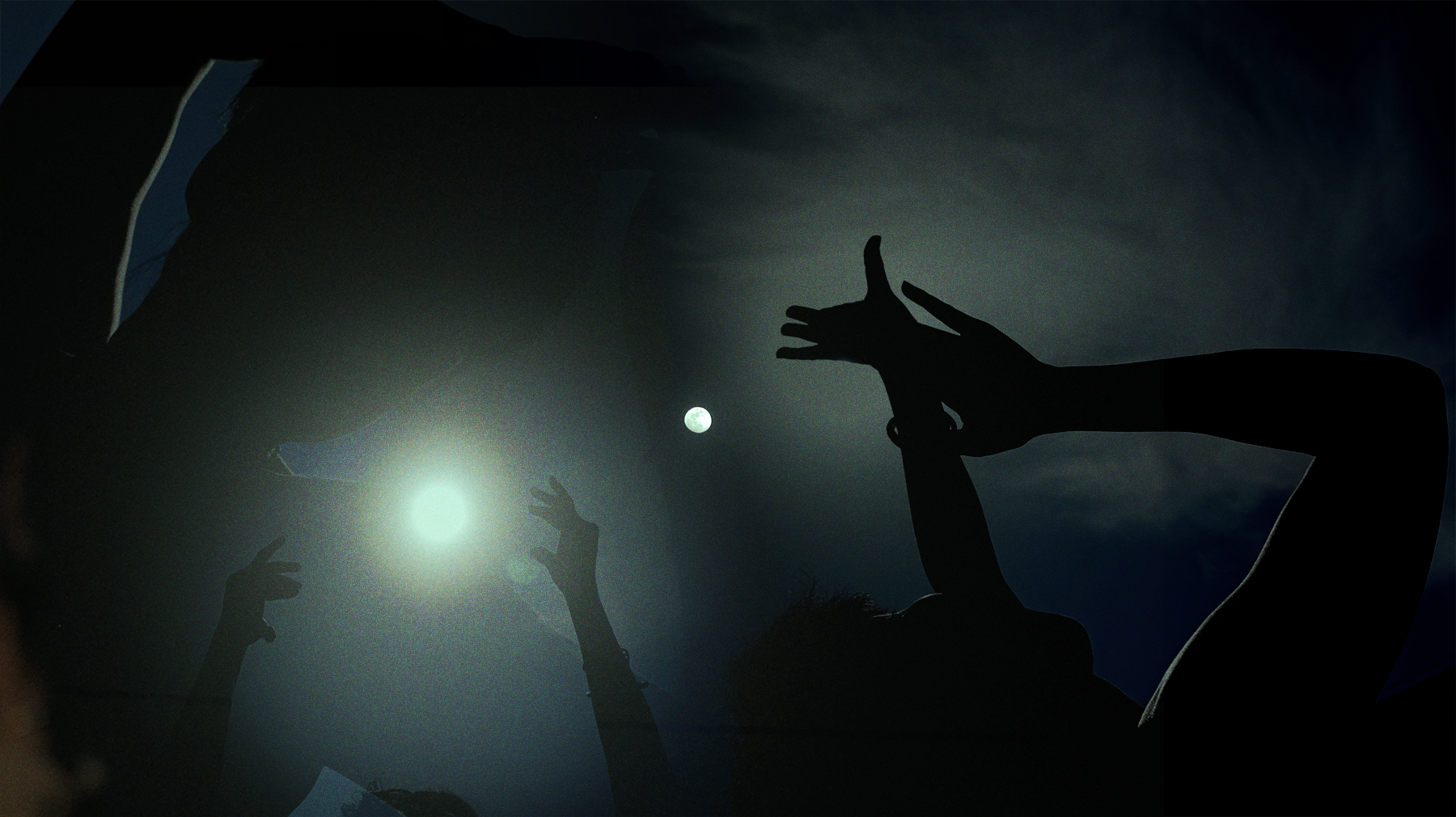
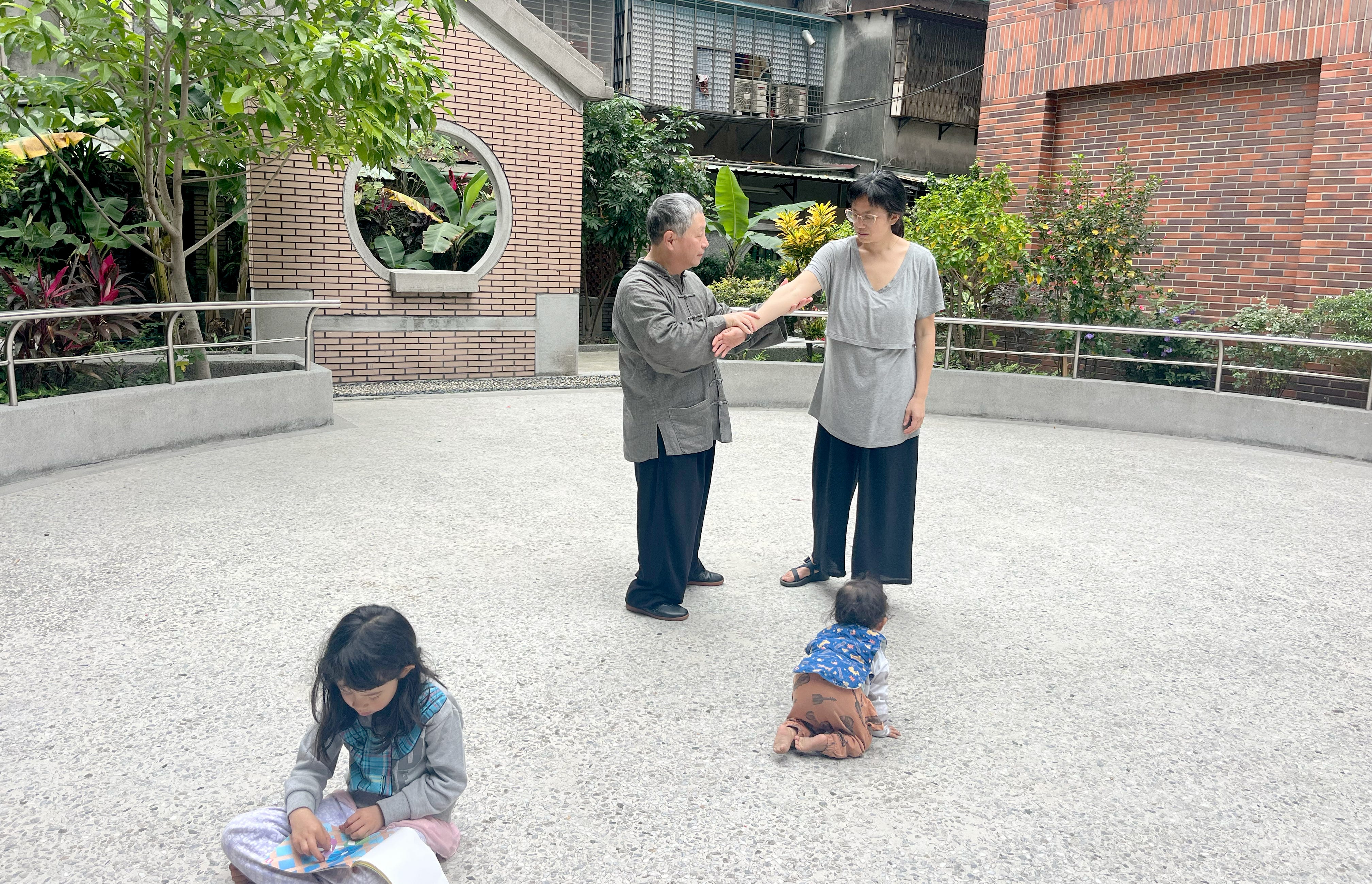
For a few days now, I’ve been watching my friend Marcia practice taijiquan with her taiji teacher.1 Sometimes I follow a little bit, but as a beginner, I’m humbled by the deeper practice, devotion, and responsibility required to fully receive these teachings.
Her teacher has been generous with his presence and the sharing of the poetic basis in which taijiquan sprouts up from. He reminds us of the requirement to be in constant awareness to our gēn 根 root while in movement. Which like the root of this ancient movement, arises from deep within the natural wisdom of the earth.
Embedded in eastern philosophies, is the wisdom of yin yang. My teachers have taught me that a separation occurs when calling it yin and yang, while expressing it as yin yang, we bow to the wholeness of a concept that cannot be separable.
As the teacher shows me moves in the taijiquan form, he points out that before he moves forward, he first returns his energy back to the source foot. Recoiling before striking, harnessing before releasing. He speaks to the importance of returning to yin as naturally as, breathing in before the out breath, into yang.

yin yang
dark light
soft hard
feminine masculine
slow fast
inside outside
receptive active
There is a wholeness to these pairs, inseparable lovers creating the bounds to an array of nuance, pulsating possibilities, slipping in and out of kinds of being that inspire the polarity of the other.
They are at their essences… relationships. Contextual conversations that shift with the seasonality of what is needed based on the timing of the rhythms of the world, the essence that each brings, and the push and pull of relationality.
What we can learn from these balances, what we can learn from our differences in relationship, is a deepening into wholeness, each time we spread our wings to enfold the opposing forces that make what is here possible.
pain pleasure
grief joy
frustration relief
ease difficulty
conflict connection
Staying connected while not being pushed away
One of the concepts that I have learned while tagging along with these taijiquan teachers is 不丢不頂 bù diū bù dīng.
不丢不頂 bù diū bù dīng describes the art of remaining in constant connection, connection to our stem rooted in the ground, our connection to spirit, our connection to our inner feeling, never abandoning this connection even when being pushed or attacked by another.
Whilst this is happening, we are also not grasping hold of, or attaching ourselves, or holding onto the other person. If we are to do so, we’re easily able to be thrown off balance.
This principle within this movement practice speaks to me relationally as well. It is by trusting our interdependence, that we can know we may remain in connection with our root to earth, to spirit, to our inner feeling, and be able to attract and maintain connection without needing to grasp hold of it.
Truly, much easier said than done.
There is a subtlety to what it takes to remain in connection when someone is pushing us, stretching us, and at times attacking us. There is a reason why the great taijiquan masters are notorious for being hermits, tucked away, not eager to share their teachings with just about anyone.
It is a humbling reminder for me, that not everyone deserves our commitment to relationality. In a culture which sees the teacher and student in a hierarchy, the teaching hinges on the skill level of the teacher. In a worldview that sees the teacher and student in a relationship of reciprocity, the student holds equal responsibility for the quality of the teachings.
If we are willing to take responsibility for the quality of our experience in relationship, we might find that the relationships we find ourselves in are only as strong as our practice.
As this nation claims victimhood while perpetuating mass violence, many in this nation claim victimhood by being matched with lovers that we diagnosis, label, and disavow as perpetrators. We do not see the power we have to shape our relationships through our own showing up in dignity, integrity, and care for those around us.
Marcia sends me the notes from her Taijiquan teacher, originating from Yang Chengfu’s ten guiding principles. A line from the notes:
十要訣:虛領頂頸、沈肩墜肘、含胸拔背、松腰落胯、分虛實、上下相隨、內外相合、
Ten tricks: Lift the head and neck lightly, relax the shoulders and drop the elbows, tuck the chest and straighten the back, relax the waist and drop the hips, differentiate between what is solid and what is empty, bottom and top in alignment, inner and outer are united.
The inner emotive realm at odds with the outer expression of our societal faces
Now that I’m surrounded by families2, I’ve held witness to the raw and wild emotions of little children in my community. I’ve seen them fully dissolve into the experience of their emotional worlds, their bodies thrashing, their voices screeching, tears shed most often at the separation between them and the mama.
In a lot of ways, I feel myself in them. When I hear them crying for their mothers, I feel the ache of all that a mother represents. The infinite care, the holding of warmth and compassion, the home that welcomes even the most furious reaction with soothing.
My inner landscape is rife with emotions that don’t know where to go. How do I contend with this anger that rises to the surface like a hot simmering sweltering summer, scorching the land with its rage? Or the torrential downpour of grief soaking the landscape with its impenetrable liquid mass releasing itself from darkened clouds shuttering out the light?
When my insides house such elemental feelings, and I am no longer able to scream and cry as a child with a mama to hold me, I am left to my own tools and devices. Often imperfect, in teetering attempts to communicate, I wonder how I can channel the unattachment of the buddha and release my emotions into the mist.
These attempts to push away my emotions, to suppress them, come from all the ways we’ve been taught to see emotions as problems to solve. I have been told that I need to rid myself of their intensity, to handle them with a professional, or to simply not feel them.
Yet, is it not the case that, the suppression of forest fires leads to larger and more intense fires down the line?
The Japanese have a few sayings that resonate with this discrepancy I feel with what is in my inner realm and what I am “allowed” to express in the outer realm. Honne 本音 is one’s true voice and tatemae 建前, our outside face.3 What is in the inner realm rarely makes it out into the open, and for the most part our outside face, our tatemae is what is more often deemed socially respectable.
In our last relationship ecology practice group,4 I heard a theme from the group: a longing to show our naked faces. The ability to be with our naked faces requires not just the willingness to dive deeply into our emotional atmosphere and barre it for others to see, but a receptiveness that can witness this nakedness as precious, important, and worthy of slowing down for. Not all can notice a delicate flower blooming for just one night, infinitely subtle but nonetheless, a rare treasure generously bridging our connection to the divine.
accepting yin to better yield our yang, learning yang to better nourish our yin
I think many of us have learnt that it isn’t safe to show our naked faces, to speak our honne, whenever we so choose. In fact, those of us who want to live in community and be trauma aware of the pain points, know that active mines burrow into the grounds of our companions’ emotional landscapes, and have astutely learnt how to hold back from the childlike mode of expressing painful internal realms as immediate distress calls.
At the same time, we are also witnessing the impacts of emotions that have been pushed underground, sealing off the source that allows us to connect in vibrant multiplicities, bridging our hearts between one another through this language of connection.5
Understanding our emotions, accessing them, requires an inner tending that for most of us, is a hard-earned skill. Not only is there the difficulty of understanding what current we are experiencing, to communicate these emotions to another person, is a whole lot of dangerous territory in knowing how and when to express.
When did emoting become so suppressed? When did staying connected to our root whilst feeling the pain of others or staying in relation without controlling others become so rife with difficulty? Where are our cultural ways to help us express our inner worlds to community?
There is no cultural protocol to rely on in modernity.
We are witnessing on a massive scale, another reckoning of the patriarchy, revealing layer after layer of deep abuse to our women and children. How shielded and ignorant we are in ignoring the layers of harm that have held up this world.
I use the word we here purposely. It feels simple and easy to point my finger and release the blame, shielding myself from any responsibility. Yet I sense that there is always a part to own, a balance to create. It is in nourishing and supporting yin where yang is encouraged to find health, and it is in wielding yang and discriminately releasing yang where yin is in her dignity.

Where we receive, we transform, where we act, we practice falling back
Yin is the receptive, the feminine, the dark, the slow, the inside, the soft. When we come to yin, we are held, heard, received, rested, brought to the slowness our tiredness lays down its head for.
Yet to remain in this place is to become stagnant, to begin to overuse this softness, get lazy and complacent in this place of hiding. If we understand that balance is a return to our center, our core, our purpose, we must know that to move from yin to yang and yang to yin, is a constant re-centering and reminding of our true natures.
As a mortal human plagued with human woes, I have had my battles with jealousy. How deeply I struggle with the feelings of a wronged woman, the rage of my grandmother moving through me, lashing out at the men in my life for their wanderings, their desires, their being different to me.
Recently I witnessed someone I like deepen with another, and I felt the familiar edge of jealousy, slithering up my spine like a snake, bringing with her a cloud of despair.
Jealousy does not live alone, and soon I was crowded by a room filled with creatures whispering into my ears the disappointments I would soon face, the embarrassment I was about to be met by, the shame I was appointed to for feeling jealousy in the first place.
The instantaneous action I felt to gather intel, to scope out the scene, to control the scenario, leapt from a fear that any inaction would shutter out my opportunity to be in the kind of relationship I have been desperately longing for – romantic partnership that has eluded my grasp for far too long.
But I know this road all too well.
And it wasn’t him I wanted to choose; it was me.
My longings spoke of the possibilities of partnership, but underneath was a deeper search… for my center.
My bazi teacher Meng says, “Yin and yang don’t achieve balance through equal amounts. You only need a little bit of yang to create harmony. That is because yin is naturally responsive. Yin’s nature is to receive. To listen, to take in. Too much yang is dangerous to all, because yang does not like to respond. It’s not receiving input the way yin is.”
In my jealousy, I was urged to act without truly responding from a receptive heart. Rather than welcoming in all the emotions, inviting each of them into my living room,6 offering them tea, taking off their shoes, giving them a place to rest and be heard, I had wanted to immediately cut off connection.
It felt easier to reject the other, than to be vulnerable with the tender longings that were arising within me. It felt like a stretch to be still when all I wanted was to seek out cues that would help me determine whether I should stay or go. Yet I knew in surrendering to yin, yang would emerge in its natural state. Not forced, not grasping, not in controlling what could never be controlled.
So, this time I didn’t search on social media for clues, I didn’t set boundaries or send passive aggressive texts. I just went inwards. I was inside for a while, maybe a few days, riding the waves, watching the fires rage, settling into the wet earth that sunk me down into the fears of a child, the rejection of a mother.
And then, slowly like the rising sun, prickles of warmth began to spread like fireflies on a hot moist southern night. My longings released into presence, and I wandered into the possibilities that would indeed reveal a different kind of story for me and this love interest. And it was okay, and I was still whole, and when he texted me a few days later, I felt the presence of our friendship, alive and well.
A backdrop to the inner tending and outer practice that he knew nothing about.
Jealousy had blocked my view of connection, the realities of relationship when held up to scale and time, how expanded I felt when able to hold uncertainty with ease. When I did respond, it was having cultivated a deep well of yin, in which my expression sprouted from a softened center that could carry my love with vulnerability and care.

we’ve got four live relationship ecology offerings this month! join our growing ecosystem of practice <3.
Their lineage is of Professor Cheng Man Ch’in
I made a commitment to myself at 29 years old when I decided I wanted to open myself to the possibility of having children, that I would start first by choosing a life deeply woven with families with children. It was to recognize that having children didn’t mean just my own, and I wanted to commit to showing up engaged with children regardless of if they were my blood.
In conversation with Kazu about this unfolding blog post when we were in Japan together, he shared with me this concept of the inner voice and the outer face.
Rishi and I have hosted two practice groups so far, where we’re still in development with how we can practice these ideas of relationship ecology in community.
I have been learning, practicing, and studying for some years now, non-violent active love practices. This has looked like communicating and touching in with needs and feelings as the basis to connecting across difference and staying heart centered.
I found myself releasing a deep sigh as I made my way through to your surrender at the end of this article. It was such a gift to listen and read along - thank you for helping me soften in my centre Kylie 🙏🏽