


I’ve recently been working as relationship accompaniment. It’s not quite mediation but a slipping into relationships when long standing conflicts, past ruptures left open, have left people stewing in the scenes of wants and desires standing frigid and alone by the roadsides.
Sometimes I call my work loving conflict, sometimes I see it as simply being a third body in a relationship dyad. My only role is to fervently devote myself to the sacredness of the relationship even when the other parties have lost hope.
What I tell the relationships I accompany:
I’m not here to save the partnership, I’m not here to even advocate for “staying together,”1 what I’m here to do is to recognize the relationship as sacred. Where relationship conflict becomes the portal to doing the work we’ve been given to doing in this lifetime.
Yet this choice, this w-holy reverence, is a path not easily chosen. It requires a desire to sit with the entanglements, to be patient enough to identify which threads we’ve woven into the ropes of another’s way of being, hoping that in so doing, we no longer need to trace the origins of our own tendrils to our original pain.
It is in my experience, that there is always something that is ours, something that is theirs, and something that is mine.
What I mean by this, is when a relational conflict or tension holds charge2 there is always something activated that is for our own independent work for personal liberation, something for the other party’s independent work for their personal liberation, and something for the dyad that is unique to the relationship dynamic that could be parceled out as a misunderstanding, an incompatibility, or expectation that is unspoken.
It is determining this in relationship, where we lay out the map of possibilities each relationship has in traversing different landscapes. There are those who we can summit mountains and dive into pitch black caverns with, and others who we are simply glad to catch a glimpse of at the watering hole.
Trudging through the mud is made easier with someone you want to struggle with.
Owning our shit becomes fun when others own their shit with gusto.
When awakening ourselves is the point over who’s in the right, finding what’s mine is a more interesting question than deciphering what’s yours.
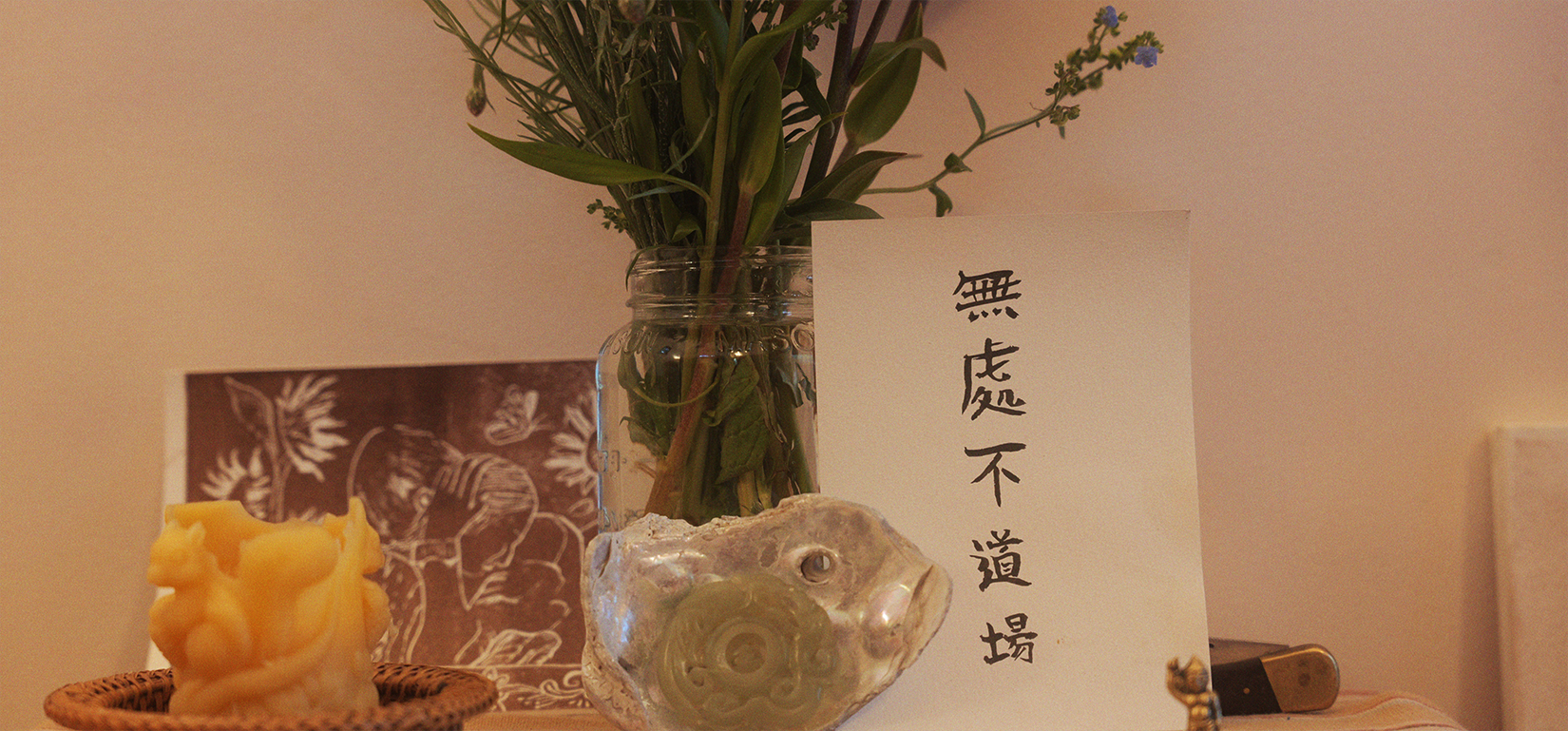
A few months ago, my friend Guangping brought me some calligraphy they wrote that said: 無處不道場。
It translates to, nowhere is not the dojo, or in other words, there is no place that isn’t the dojo.
The Dojo3 or otherwise known as 道場 is made up of two characters, 道 dào is often translated as the way, it is the 道 dào in sacred text, 道德經 dào dé jīng, and 場 chǎng is often translated as the space around, the field. When we see 道場, the dojo, we might think of a gym, or a place where we’re training in martial arts.
But this saying, 無處不道場, there is no place that isn’t the dojo, where I’m reminded that everywhere is the dojo, and as somebody invested in the healing of the world, the arena of relationality is the practice grounds to meaningfully confront the ancestral and personal pain that originated from relationality itself.
We are hurt in relationship, garner a whole host of protectors from this hurt, and spend lifetimes never integrating these protectors, shielding our hearts from staying open. Our hearts are precious, and keeping ones heart open isn’t skillful if we lack the discernment to gauge whether we have enough resource to be open and responsive and/or met by somebody who can recognize our heart for what it’s offering.
I’ve learnt that who we practice with, is the most important consideration when attempting to strengthen our hearts to staying open and responsive. If we can meet the other with love at no cost to the love we have for ourselves, we stretch into trusting that we can remain open and responsive.
In a relationship ecology, we have a wide range of practice partners.
The most common space of intimacy in modernity is a nuclear, romantic dyad, where if severed from the collective, has the potential for creating a highly anemic environment.
When there is a lack of oxygen, movement, and flow that other relations offer, a dyad can become highly imbalanced, skating by through the reliance on normative rules contained to regulatory practices of heteronormative forms of control4 and privatization. Hiding the inner world of a relationship from the public eye is imperative to the continuation of these forms of anemic partnerships.
These two patterns: control of another’s being and the privatization of what is meant to be held in response-ability by the collective, are not only dominant relationship patterns but reflections of the culture we live in.
Our human ancestors consistently endured forced separation finding relief in strategies that could give them a sense of security. Yet this clamping down, this freezing of the other, creates a type of security that denies wholeness, making modern relationality about parceling ourselves into pieces of who we are.
The ecology, in its diversity of relations and relational roles points us towards regeneration and decomposition as forms of securing life.
When we step into the dojo with the ecology as a guide, with an intention of queering our relational worlds finding pathways that are rigorous with protecting our wholeness while fiercely advocating for our need of security by partnering with life, we also get to choose who we practice with and how we practice, as agents of change.
Who gets to enter our relational dojo?
In the past I prided myself as a person who was always available for repair. I felt that part of my skill was the willingness I had to enter the arena with anybody. I was ripe and ready to be faced with whatever the other person had for me to contend with.
It was early this year where I began to earnestly confront this part of me. I saw that my willingness to repair with anyone was a protective mechanism used to create a visage of “being better at relationship” because I could tell myself I was always here for the hard stuff (unlike the other person). I thought that if I was always available for relationship tending, the unavailability of the other could be chalked up to them being less serious about relationality.
By steeping in the waters of righteousness, I would place the blame of relational rupture on the lack of willingness and skill in the other rather than feeling all the feelings of rejection and grief that arrived when relationships would rupture.
Through my practices of whole-ing5, I softened to my rejected self. I witnessed her, sat beside her, inviting her to lay her head in my lap. And in making space for her, I saw that by acknowledging her, I got in tune with my dignity. When I allowed my pain and rejection to exist, I could honor that there was a genuine unavailability for relational repair with those who did not have the capacity to soften alongside me.
I gave myself the agency to choose who got to enter the dojo with me. That rather than seeing my dojo as having an open-door policy where anybody could waltz in and sling whatever they had to discharge in my direction, I could set within this dojo the intentionality for a kind of practice where the baseline was honor, dignity, respect, and presence.
That hanging on the walls of this dojo are mirrors that reflect to each person in the room their work to do. That here, there was no space for one-sided-ness (especially from myself), and this dojo held a purpose rooted in healing ancestral trauma. This dojo required one to face oneself as a prerequisite to any form of partner work.

The work, in service to living in trust
I do not subscribe to this idea that the purpose of procreation is for survival.
A theory so void of interdependent sacredness that survival is the best scenario to explain a species purpose for aliveness, sucks the mystery out of a world that is constantly reminding us of its emergent properties, its godly flows, its transcendent luminosity.
In indigenous and earth-bound origin stories, the birth of a species, the creation of humanity, often holds mystical properties. In these origin stories,6 like those of the native peoples from the region around the great lakes of North America, beings like the turtle and the muskrat play integral roles to support sky woman on her descent onto earth leading towards the eventual birth of their first people.
Rather than seeing the world around us as something we had to survive against, this origin story views the world around us as conspiring towards our aliveness, supporting us in our creation, singing songs that want us to be thriving, reminding us of our role as stewards responsible in turning towards those who have ensured our place here on earth.
It is in recognition that no matter how isolated we might feel, or severed we’d like to be from our relations, we are indeed reliant on a whole host of beings to be here, breathing, awake, and searching for meaning. Turning towards our relations and learning to heal together, to stay tethered yet free, to become stewards of each other’s gardens, is to recognize and acknowledge the truth of how supported we are by these very same relations.
The work that we do in relationship, the owning of what is ours, the practice field where we get to grow in trust with each other by parceling out what’s yours, what’s mine, and what’s ours, is a gift to the wider web. When our relationships are intentionally held as the dojo that skills us up to be available for our relationship to the world around us, we can recognize that our trust with the world is in response to our trust within relationships.
That the feeling of ease we want for our own lives which we often attempt to extract from our partners, can only abound when we take on the work of owning what’s ours, and to do so, means surrendering to the guidance of the unseen and seen beings that permeate and support our lives.
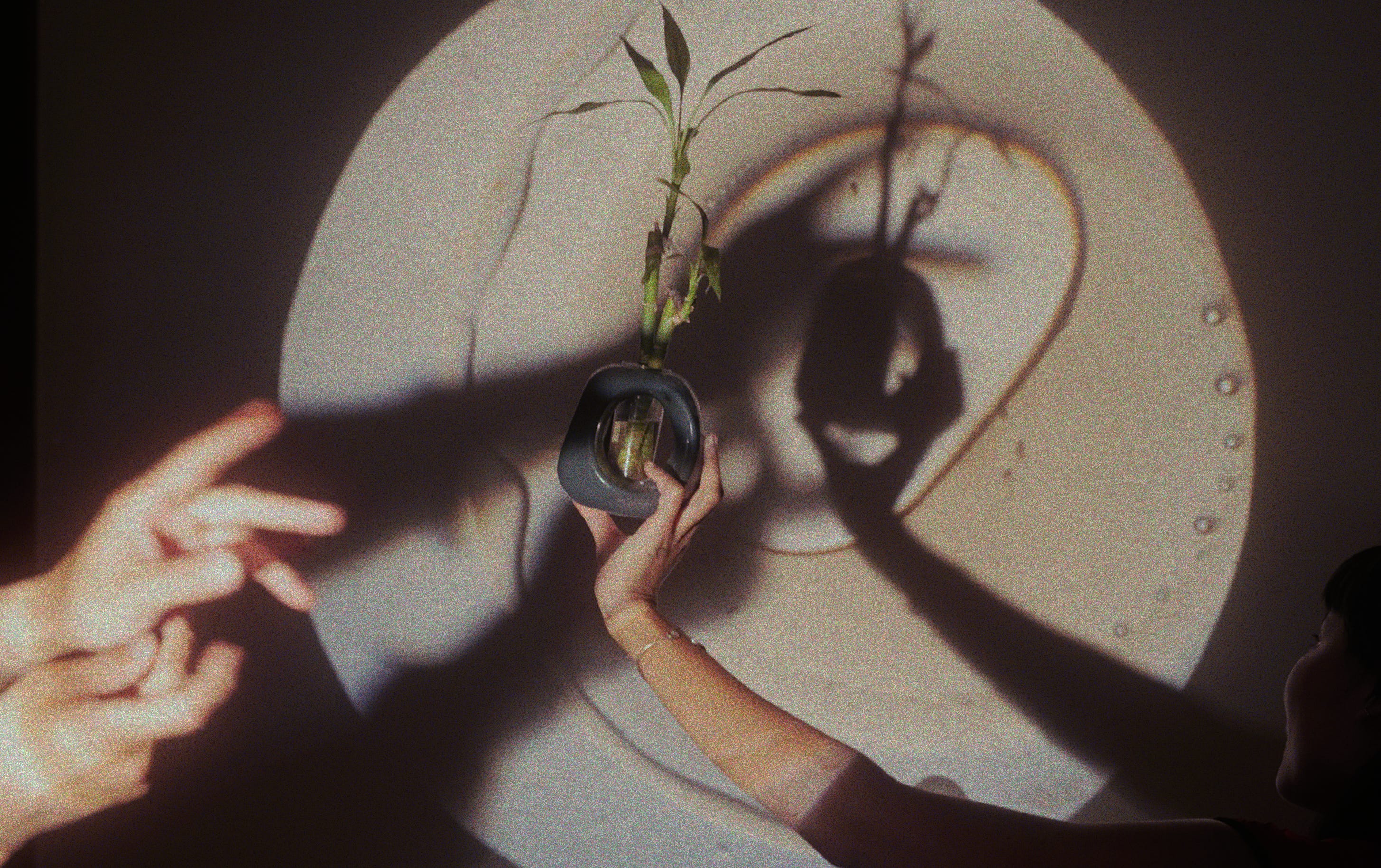
What’s ours is not just ours, but where our roots have been torn
As a descendent of three generations of immigrating people, first from our homelands in China towards the mountainous regions to flee from Japanese colonization, then towards Taiwan away from the communist regime, and then towards Argentina/US for economic security, the roots of my lineage have been deeply impacted by movement, and the adjustment to new lands.
What my relatives have rooted to, found safety in, home within, has been both the imperialist project of the US, and the modern Chinese government. The more these systems represent power and security, the more they become practical taproots for root systems that have been frayed and torn, root systems that have lost sense of the textures of their original landscape.
I know that I only have the freedom to challenge these patterns because of the choices my family made that gave me enough space for my roots to branch out. That their connection to conceptions of security in modernity, was part of my ability to feel the reverberations of what had to die in order to embody the severance required to excel within a culture that sees anyone outside of the nuclear family paradigm as untrustworthy.
That everyone for themselves isn’t a lifestyle choice, but the result of moving vast distances away from relations that did care for each other. An inner intelligence that created a protective shield anticipating the next move away from the land and the people that had once supported one’s well-being.
Whatever has been severed comes back in our relationships. Our severance to our divine feminine, our severance to our self-worth, our severance to our knowing of our purpose and belonging to the world, will without a doubt rise hungrily to be seen when we attempt to re-weave wholeness in relationship with another.
Only in relationship, are we mightily faced with the gaps, the longings, the unmet needs, and given a mirror in which we might face or stagnate our changes, able to look away when we choose to disengage from the feelings arising from the other or within ourselves.
To do our work is to engage with our histories, to welcome the past spirits that have stories to tell, to face each protector with the courage to love, see, and understand their pain.
Our work is ancestral, it is old, it is excavation, it is wandering into the field, lightening our load, so that those who come after us can root just a bit farther, soaking up nutrients to grow new directions that were just beyond our reach.
Incompatibilities, misunderstandings, and expectations, our work takes endurance
Recently in one of my relationship sessions, someone expressed the despair and hopelessness they felt in their partnership. We talked about how that hopelessness might be a protector preventing him from the disappointment of giving himself fully to the relationship, how despair was grappling with the real limitations of partnering in this society, as well as pointing to real incompatibilities.
When I talk about the what’s ours part of the equation, what I am oftentimes referring to here is identifying whether there’s an incompatibility, a misunderstanding, or an unspoken expectation or agreement passed down by our trauma-bound reactivity to relationships and relationship culture.
Sadly, we inherit boatloads of preferences and expectations, methods of maintaining false peace and a stronghold on our needs without ever having to do the work of identifying those needs.
Another tragic part of our extremely nuclear partner oriented society is that incompatibilities feel like walls rather than doors. When we rely on our romantic partner to meet us in all and every capacity, when there’s an incompatibility, we might despair rather than recognize the invitation towards introducing a new ecosystem function that breathes oxygen into the whole system.
What eight years of communal living has taught me; there is not so much use in trying to get people to change some of their innate habits and patterns. There will definitely be growth over a long period of time, but the harmony I need in my home space is cultivated through listening to spirit, knowing myself well to identify a good fit, and accepting people’s gifts. We are all trying our best to create a living, and moving, system in which those who love to clean the bathroom create the space for those who love to reorganize the living room.
Rather than asking for change from those I practice partnership with, I try to invite movement and change into the systems I cultivate, so what naturally thrives is drawn and what atrophies leaves.
When it comes to misunderstandings, if we are unable to cultivate working feedback loops or systems where no one person holds the full responsibility for creating a space to release tension, misplaced words will eventually worm their way into the foundation of our relationships rotting them from the inside.
Our work is about skilling up so we give ourselves the best chance to attend, attune, and reorient to a living organism alive in a dynamic, seasonal, ecosystem. When we go about our relationships unconsciously, we will without a doubt default into treating each other as frozen objects functioning to meet our needs. This is a reflection of the water we’re swimming in, and it takes active intentionality to recognize incompatibilities as invitations towards weaving with other relations, misunderstandings as reminders to create sacred space to tend to our relationship garden, and the courage to creatively define the relationship; slowing down enough to ask whether these expectations serve us?
Relationship ecology requires endurance, and we’ll be offering a group space called Villaging in the Imperial Core, for those who want to be in an active practice with those committed to villaging in their local communities and creating…
Ecologies of depth and distance
As I continue to uncover what is my work, learn how not to take on other’s work, and become more skillful at identifying what might be our work, I have found that my ecology begins to reflect more the natural phases and cycles of the landscapes around me.
What I have come to understand about the dao 道 is that arising occurs when we are in touch with both our root to the earth and our connection to the heavens. Our root identifies what our bodies have been given, our birth placement, our ancestral inheritances, our bodily functions, while the heavens endow us with our role in the world, the healing potential we offer when in sync with the purpose whispered by the gods as our spirit slipped into our mother’s womb.
What we are working out in the relational dojo, is not a mere hinderance to the kind of nuclear partnership made from happily ever afters, but the obstacle course placed to grow us into the mythic poetic seeker that can meet these times with such a deep well of knowing sorrow that the pain of the world is understood as part and parcel to our own experience of life.
Increasingly, we fear the consequences of being in relationship. As we find more availability to customize our emotional experiences through technological curation, we sequester ourselves away from the messiness of the work that is served up each time we deepen in intimacy. The paradox of tightening what we expose ourselves to, is that each time we tighten the latch, we rely more on the latch to keep us safe then on our own capacities for meeting the moment.
As we cling closer to the tap root of cultural legibility, our ability to grow our roots outwards in search of what our hearts more deeply long for begins to wane.
To center the work in relationship, means finding unusual pathways towards expansion, wetlands where we wade into mystical landscapes of plant deities and ancestors from times past, seeing that inner work is acknowledging root systems that grieve severance from the echos of once being engulfed in a love that belonged to all of us.
Following this call, knowing that our longings to be welcomed into wholeness, is not meaningless, but a declaration of our place within creation that is conspiring for us to meet our pain as portal, where the material of the unknown becomes our palette to paint with those who can meet us in our depth-ful-ness.
One of the modern relationship norms is judging a relationship’s strength through how long a relationship is. This norm has people staying fixed in relationship patterns that support the exterior structure of a relationship while the inner world of a relationship brews an anemic blend of stagnation, resentment, and dishonesty.
Charge in relationships can feel invisible when we’re used to unresolved conflict in relationships (a circumstance many of us grew up in). The more we feel what a regulated nervous system feels like, and the more that becomes the norm, charge in relationship becomes much more visible and even minor charge can become perceptible and more easily acknowledged.
Dojo is the Japanese pronunciation of 道場, and also a much more commonly accepted and understood word in the west, thus I am using it here because it holds more cultural context than the chinese pinyin of 道場 dàochǎng.
It is common for heteronormative pairings to barre each other from having opposite sex friends, to practice forms of financial intimacy with other people, and to seek comforting touch from other relationships.
whole-ing is the invitation towards all our parts. see rumi poem: the guest house
This origin story is shared across different native tribes around the great lake region, and is the root of the term: turtle island, used often to describe the current lands of the Americas